
[논문 리뷰] FlashAttention: Fast and Memory-Efficient Exact Attention with IO-Awareness
“FlashAttention” 논문은 스탠포드 대학교 박사 과정 학생인 Tri Dao가 Transformer 모델에서 긴 시퀀스를 처리할 때 self-attention 메커니즘이 메모리와 계산 효율성 면에서 비효율적인 문제를 해결하고자 제안되었습니다. 해당 연구는 2022년 5월에 arXiv에 처음 공개되었으며, 이후 NeurIPS 2022(Advances in Neural Information Processing Systems)에서 포스터 발표 형식으로 소개되었습니다.
<img src="../../images/2025-04-05-int_flashatttention/image-20250405182831999.png", style="width: 80%;">
해당 이미지는 FlashAttention의 핵심 아이디어를 설명합니다.
메모리 계층 구조
GPU는 SRAM, HBM(High Bandwidth Memory), CPU DRAM으로 구성된 메모리 계층 구조를 가집니다. FlashAttention은 이러한 계층 구조를 고려하여 메모리 접근을 최적화합니다.
작동 방식
Tiling : FlashAttention은 입력(Q, K, V)를 블록으로 나누어 SRAM에 불러오고, 블록단위로 Attention을 계산합니다.
Outer Loop : K와 V 행렬의 블록을 순회하면서 SRAM에 불러옵니다.
Inner Loop : Q 행렬의 블록을 순회하여 SRAM에 로드하고 Attention 계산 결과를 HBM 에 저장합니다.
여기서 핵심은 큰 Attention 행렬을 HBM에 저장하지 않고, 필요할 때마다 SRAM에서 계산하여 메모리 접근을 줄이는 것입니다.
연산 속도 비교
Pytorch는 Matmul, Mask, Softmax, Dropout 등의 연산을 순차적으로 수행합니다.
FlashAttention은 이러한 연산들을 Fused Kernel로 통합하여 처리합니다.
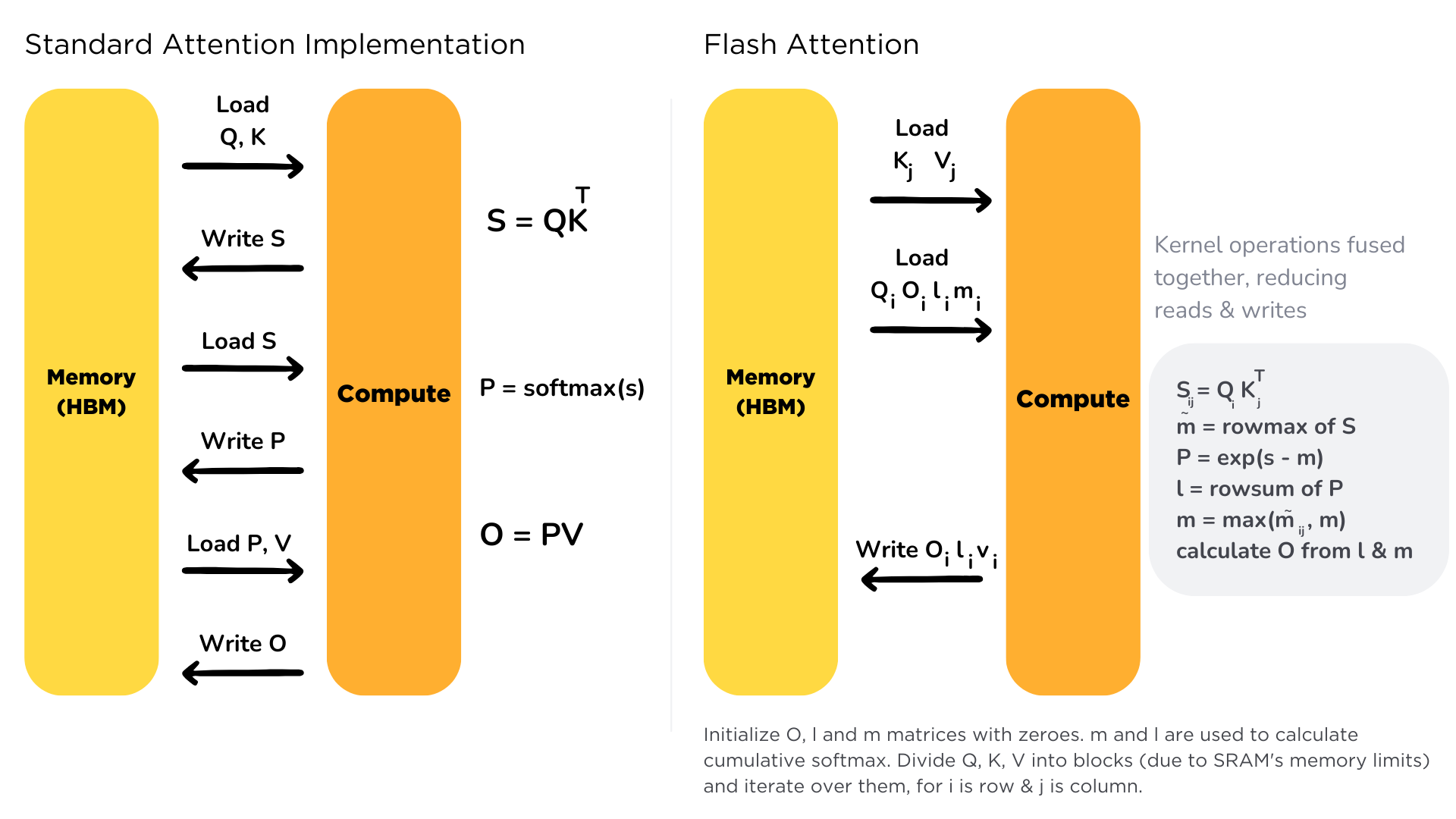
Standard Attention Implementation
입력 시퀀스 $Q, K, V \in \mathbb{R}^{N \times d}$ 에서 $N$은 시퀀스 길이이고, $d$ 는 헤드 차원이입니다. 최종적으로 $O \in R^{N \times d}$ 를 계산하는 것이 목표입니다.
\[\begin{align*} \mathbf{S} &= \mathbf{QK}^T \in \mathbb{R}^{N \times N} \\ \mathbf{P} &= \text{softmax}(\mathbf{S}) \in \mathbb{R}^{N \times N} \\ \mathbf{O} &= \mathbf{PV} \in \mathbb{R}^{N \times d} \end{align*}\]| (Algorithm 0) Standard Attention Implementation |
|---|
| Require : Matrces $Q, K, V \in \mathbb{R}^{N \times d} $ in HBM. |
| 1: Load $\mathbf{Q, K}$ by blocks from HBM, compute $\mathbf{S = QK^T}$, writh $\mathbf{S}$ to HBM |
| 2: Read $\mathbf{S}$ from HBM, compute $\mathbf{P} = \text{softmax}(\mathbf{S})$, write $\mathbf{P}$ to HDM |
| 3: Load $\mathbf{P}$ and $\mathbf{V}$ by blocks from HBM, compute $\mathbf{O = PV}$, writhe $\mathbf{O}$ to HBM |
FlashAttention
주어진 입력 $Q, K, V \in \mathbb{R}^{N \times d}$ 를 HBM에서 가져와, 어텐션 출력 $O \in \mathbb{R}^{N \times d}$ 를 계산하고 HBM에 기록하는 것을 목표로 합니다.
Tilting
벡터 $x \in \mathbb{R}^{B}$ 의 소프트맥스 계산은 다음과 같습니다.
\[\begin{align*} m(x) &:= \underset{i}{\max} x_i \\ f(x) &:= [e^{x_1-m(x)} \dots e^{x_B-m(x)}] \\ \ell(x) &:= \sum_i f(x)_i \\ \text{softmax}(x) &:= \frac{f(x)}{\ell(x)} \end{align*}\]벡터 $x^{(1)}, x^{(2)} \in \mathbb{R}^B$에 $x = [x^{(1)} \; x^{(2)} \in \mathbb{R}^{2B}]$ 로 연결된 소프트맥스를 다음과 같이 분해할 수 있습니다.
\[\begin{align*} m(x) &= m([x^{(1)} \; x^{(2)}]) = \max(x^{(1)}\; x^{(2)}) \\ f(x) &= [e^{m(x^{(1)}) - m(x)} f(x^{(1)}) \quad e^{m(x^{(2)}) - m(x)} f(x^{(2)})] \\ \ell(x) &= \ell([x^{(1)} \; x^{(2)}]) = e^{m(x^{(1)}) - m(x)} \ell(x^{(1)}) \quad e^{m(x^{(2)}) - m(x)} \ell(x^{(2)}) \\ \text{softmax}(x) &= \frac{f(x)}{\ell(x)} \end{align*}\]| (Algorithm 1) FlashAttention |
|---|
| Require: Matrices $\mathbf{Q, K, V} \in \mathbb{R}^{N \times d}$ in HBM, on-chip SRAM of size M. |
| 1: Set block sizes $B_c = \lceil \frac{M}{4d} \rceil, B_r = \min(\lceil \frac{M}{4d}, d \rceil )$. |
| 2: Initialize $\mathbf{O} = (0)_{N \times d} \in \mathbb{R}^{N \times d}, \ell = (0)_N \in \mathbb{R}^N, m = (-\infty)_N \in \mathbb{R}^N$ in HBM. |
| 3: Divide $\mathbf{Q}$ into $T_r = \lceil \frac{N}{B_r} \rceil$ blocks $\mathbf{Q_1, \dots, Q}_{T_r}$ of size $B_r \times d$ each, and divide $\mathbf{K, V}$ in to $T_c = \lceil \frac{N}{B_c} \rceil$ blocks. |
| 4: Divide $\mathbf{O}$ into $T_r$ blocks $\mathbf{O}_1$, $\dots,$ $\mathbf{O}_{T_r}$ of size $B_r \times d$ each, devide $\ell$ into $T_r$ blocks $\ell_1, \dots, \ell_{T_r}$ of size $B_r$ each, and devide $m$ into $T_r$ blocks $m_1, \dots, m_{T_r}$ of size $B_r$ each. |
| 5: $\text{for } 1 \leq j \leq T_c \text{ do}$ |
| 6: $\quad$ Load $\mathbf{K}_j, \mathbf{V}_j$ from HBM to on-chip SRAM |
| 7: $\quad$ $\text{for } 1 \leq i \leq T_r \text{ do}$ |
| 8: $\quad \ \ \quad$ Load $\mathbf{Q}_i, \mathbf{O}_i, \ell_i, m_i$ from HBM to on-chip SRAM |
| 9: $\quad \ \ \quad$ On chip, compute $\mathbf{S}_{ij}$ = $\mathbf{Q_i K_j^T} \in \mathbb{R}^{B_r \times B_c}$ |
| 10: $\quad \quad$ On chip, compute $\tilde{m}_{ij} = \text{rowmax}(\mathbf{S}_{ij}) \in \mathbb{R}^{B_r}$, $\tilde{\mathbf{P}}_{ij} = e^{\mathbf{S}_{ij} -\tilde{m}_{ij}} \in \mathbb{R}^{B_r \times B_c} \text{ (pointwise)}$, $\text{resume}(\tilde{\mathbf{P}}_{ij}) \in \mathbb{R}^{B_r}$. |
| 11: $\quad \quad$ On chip, compute $m_i^{\text{new}} = \text{max}(m_i, \tilde{m_{ij}}) \in \mathbb{R}^{B_r}, \ell_i^{\text{new}} = e^{m_i - m_i^{\text{new}}}\ell_i + e^{\tilde{m}_{ij} - m_i^{\text{new}}}\tilde{\ell}_{ij} \in \mathbb{R}^{B_r}$, |
| 12: $\quad \quad$ Write $\mathbf{O}_i \leftarrow \text{diag}(\ell_i^{\text{new}})^{-1} (\text{diag}(\ell_i)e^{m_i - m_i^{\text{new}}} \mathbf{O}_i + e^{e^{\tilde{m}_{ij}} - m_i^{\text{new}}}\tilde{\mathbf{P}}_{ij}\mathbf{V}_j)$ to HBM |
| 13: $\quad \quad$ Write $\ell_i \leftarrow \ell_i^{\text{new}}, m_i \leftarrow m_i^{\text{new}}$ to HBM |
| 14: $\quad$ $\text{end for}$ |
| 15: $\text{end for}$ |
| 16: Return $\mathbf{O}$. |